
QS3 software
scanning NV as simple as AFM
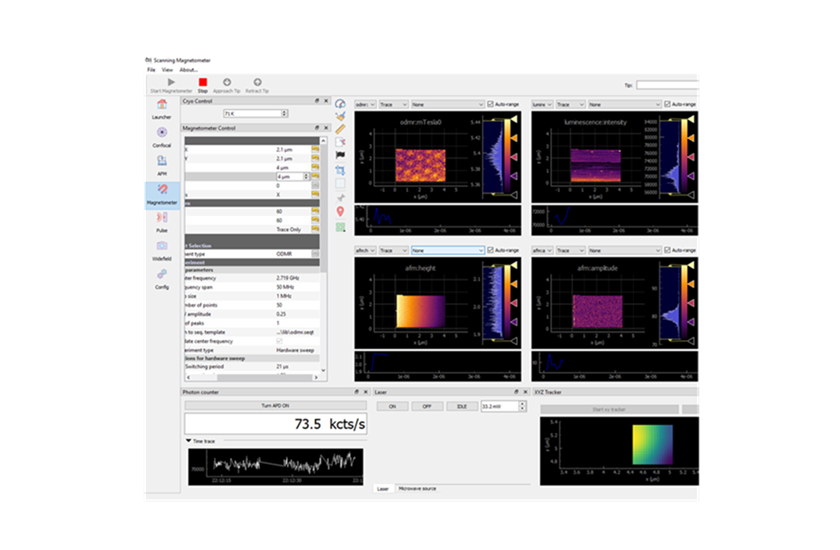
The QS3 software is based on the experience and the requirements of expert NVM users, combining functionality and user-friendliness. The intuitive software interface enables a jump start into the world of imaging magnetic fields and electric currents. Here is the short overview of main measurement modes:
Photoluminescence: Magnetic fields modify the fluorescence rate of the NV, indicating where the field is stronger and where it is weaker. Since it only measures the fluorescence, it is a very fast, but only qualititave measurement.
Iso-B: Iso-B mode measures the ratio of two microwave frequency points centered around a specific frequency and about the line width apart to create contours of equal field. A fast measurement that is quantitative for small field changes.
CW-ODMR: CW-ODMR mode measures the full resonance curve by continually applying the laser and microwave field to map the fluorescence response. Fully quantitative with additional information in the contrast, countrate and linewidth.
Tracking: Strong variations in the magnetic field shift the resonance significantly. This either requires a large frequency window for ODMR, which decreases signal-to-noise, or, to avoid this, a dynamically moving, small window.
Pulsed ODMR: At each frequency point the NV is initalized with a laser pulse, followed by a microwave pi pulse and laser readout pulse. This avoids power broadening, the more narrow linewidth and higher contrast increase the sensitivity to better than 0.5 µT/ (Hz1/2).