
Why attocube is the ‘Quiet Enabler’ of Quantum Innovation
10 Nov 2025 | written by Joe McEntee
Sparrow Quantum designs and develops single-photon and entanglement sources for applications in quantum computing, quantum metrology and early-stage quantum networks. Thanks to enabling technologies from attocube, the Danish company is now translating the ‘hard yards’ of pre-competitive and applied research into product innovation and manufacturing scale-up.
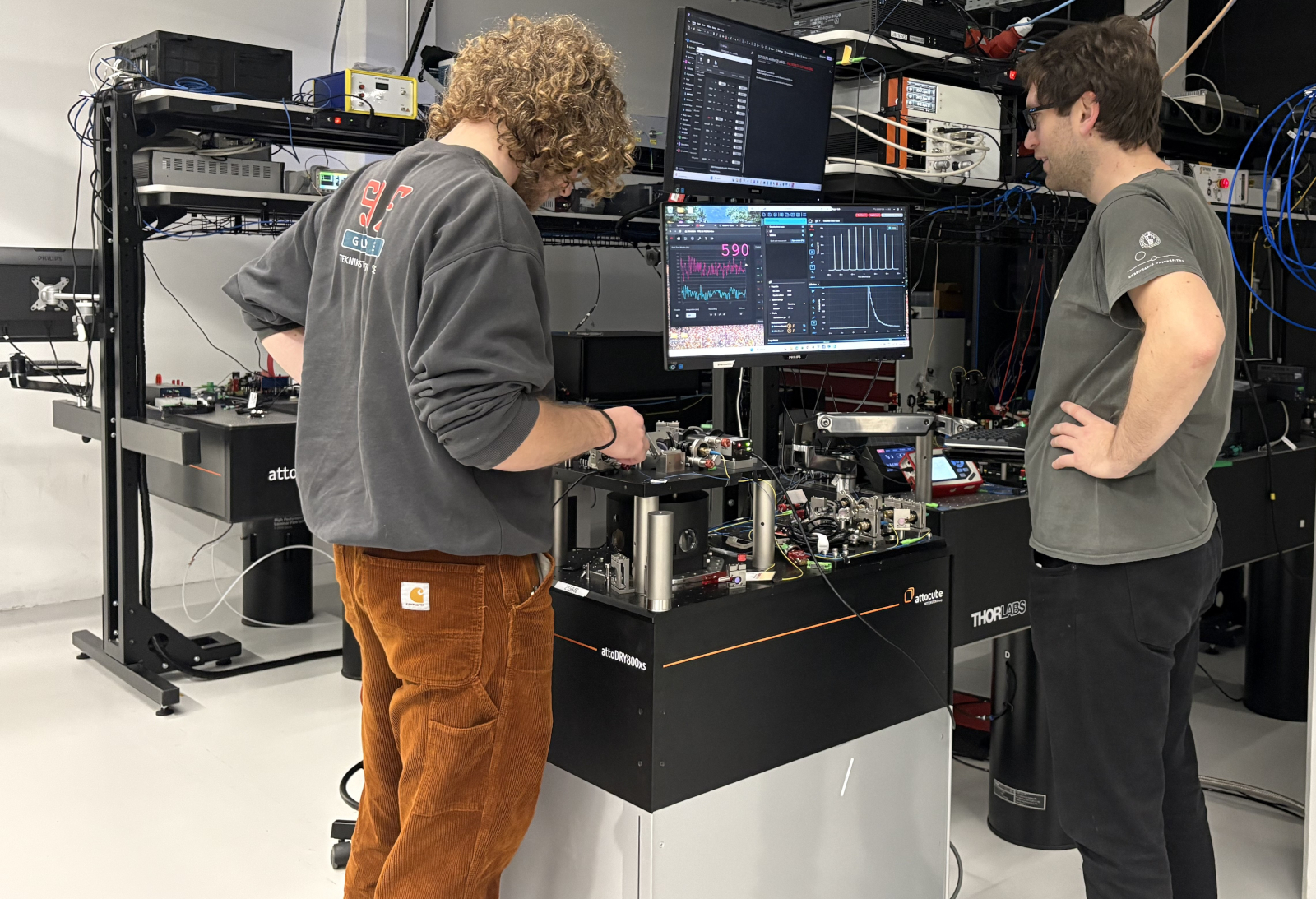
Out of the lab, into the market: attocube’s cryostats and nanopositioners are helping the Sparrow Quantum R&D team to set new performance benchmarks for quantum-dot sources – not just in terms of efficiency, but also alignment stability and reproducibility. (Courtesy: Sparrow Quantum)
Relentlessly, assuredly, inevitably – Sparrow Quantum is busy shaping a photonics-driven revolution in quantum science and technology. Earlier this year, the Copenhagen-based developer of photonic quantum chips was boosted by a €21.5 million investment round (a follow-on from earlier seed funding of €4.1 million) that will enable it to meet burgeoning demand for photonic quantum hardware by accelerating R&D and scaling chip production while bringing its next-generation quantum devices to market.
If that’s the headline, what of the detail? Sparrow Quantum builds on a rich legacy of fundamental breakthroughs in quantum science – a legacy that, it hopes, will deliver a core technology platform into the nascent quantum supply chain. While at the Niels Bohr Institute in Copenhagen, Sparrow founder and Chief Quantum Officer (CQO) Peter Lodahl conducted research that laid the groundwork for the company’s flagship product – an optical chip called Sparrow Core that can generate on-demand (deterministic) and highly coherent (indistinguishable) single-photon streams.
Sparrow takes flight
In the past decade, following the company’s spin-out from academia, the Sparrow team has overcome the inherent noise and decoherence processes of its on-chip platform so they exceed the benchmarks on generation efficiency and photon indistinguishability required for scale-up to real-world deployment. Crafted from ultra-precise InAs/GaAs quantum-dot structures embedded in photonic-crystal waveguides, the 3x3 mm Sparrow Core chip emits single photons at discrete wavelengths between 920–980 nm (with quantum information stored in different properties of the photon).

Reimagining quantum: “We are positioning ourselves as a key component/subsystem vendor for the full-stack developers of photonic quantum computers,” says Peter Lodahl, CQO of Sparrow Quantum. (Courtesy: Sparrow Quantum)
Performance specifications include the generation of long strings of more than 100 single photons without any observable decrease in the mutual indistinguishability between photons (V > 97%); best-in-class efficiency (how many photons emitted into a Gaussian mode ) of greater than 80%; and a purity (how well the source avoids emitting multiple photons at the same time) in excess of 99%. The result? More than 40 million single photons per second that can be directly deployed into an optical fibre.
“What’s not to like,” says Lodahl. “We have deterministic single-photon sources; we have scalable planar-waveguide-based technology; and we have intrinsically high coupling efficiencies into fibre. Even better, our waveguide technology is extremely broadband [tens of nm] to give robustness and flexibility for different applications, while the ultra-low-noise performance ensures the highest fidelity in single-photon generation.”
Right now, Sparrow is majoring on technology translation and scale-up, embedding Sparrow Core technology with multiple customers so that it can mature in a commercial setting. Product validation is wide-ranging across the company’s established base of research customers – including groups at the University of Vienna and the University of Warsaw conducting advanced quantum optics experiments with single-photon sources.
Increasingly, though, Sparrow’s growth trajectory is trending towards systems integrators – a case in point being the supply agreement with ORCA Computing, a UK developer of full-stack photonic quantum computing systems. “We are positioning ourselves as a key component/subsystem vendor for the full-stack developers of photonic quantum computers,” says Lodahl. “Strategic partnership with such companies is our commercial priority for the next decade.”
Either way, turning Sparrow’s disruptive photonic technology into new quantum products and applications is a very different proposition to managing a research team at the Niels Bohr Institute. “While the starting points may be similar – i.e. understand the fundamental physics and then put the engineering around it,” notes Lodahl, “it’s always been clear to me that Sparrow only really works as a company in the traditional sense rather than as an extension of a university research group.”
He continues: “Only in industry can we actually build these advanced quantum technologies, which in turn requires us to put together a highly innovative, focused and collaborative team of experts who are all pushing in the same direction. It is truly inspirational to be part of such an endeavour.”
Technology partnership, quantum innovation
Whether in the academic or industry setting, collaboration with attocube has been a constant throughout Lodahl’s journey from pioneering research scientist – probing the fascinating properties of quantum dots, when the field was still defining its boundaries – to technology entrepreneur – optimizing the performance of the latest generation of Sparrow Core single-photon sources.
“While attocube is deeply rooted in the scientific community, we are also a natural technology partner for companies like Sparrow in the emerging quantum industry,” explains Florian Otto, Director of Business Sector for Cryogenic Instruments at attocube. “Our leading-edge capabilities in cryogenics and precision motion are the ‘quiet enablers’ of quantum innovation – critical but not centre-stage.”
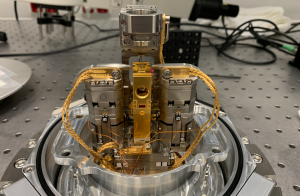
Think compact and low-vibration closed-cycle cryostats (with low-heat-generation compressors) to maintain delicate quantum states and processes. Also, crucially, attocube’s low-temperature nanopositioners – delivering nanometre precision at cryogenic temperatures – to align Sparrow’s photonic chips with optical fibres and other components. “These nanopositioners ensure repeatable, drift-free positioning during long experimental runs and industrial validation – a prerequisite for scaling Sparrow’s single-photon sources from laboratory prototypes to commercial devices,” says Otto.
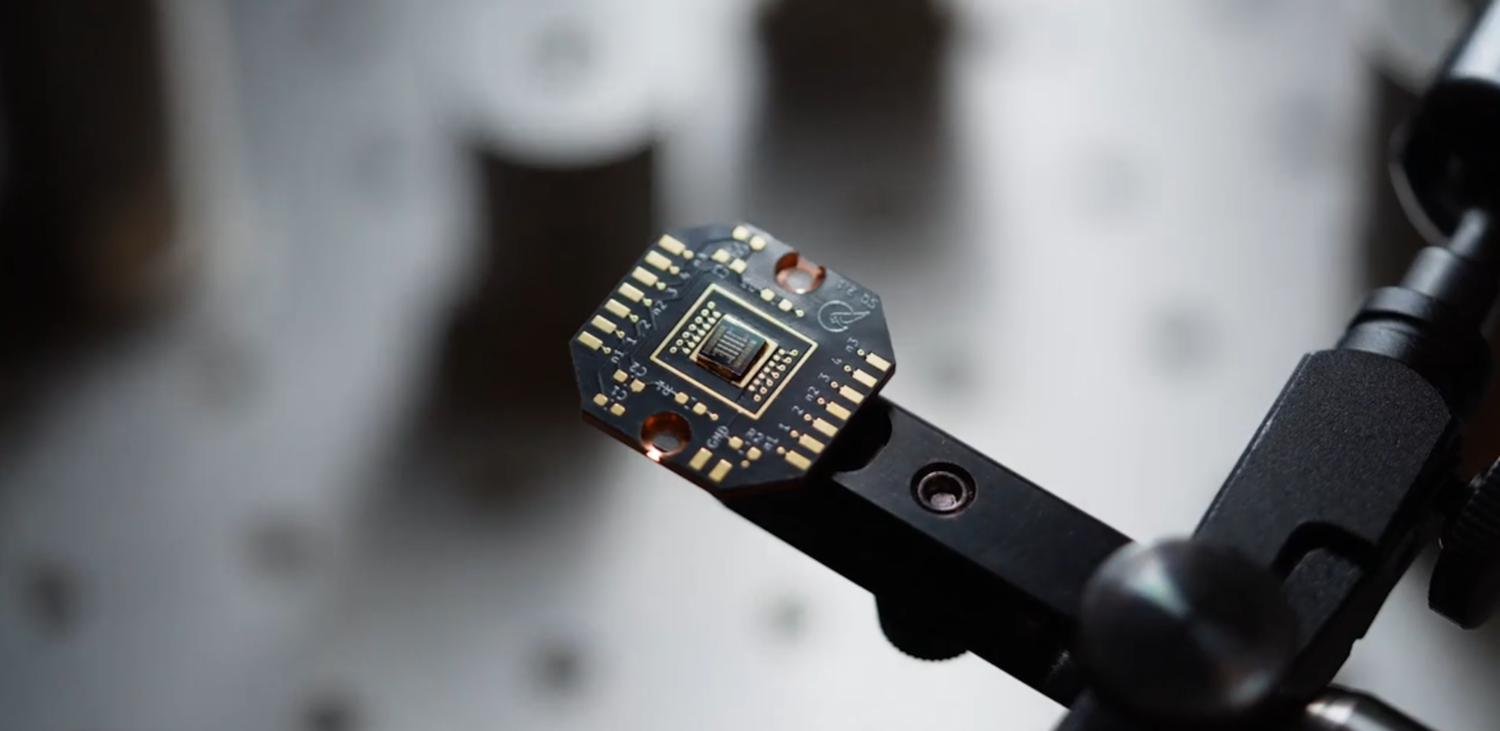
Think small, win big: Sparrow Quantum’s Sparrow Core optical chip generates on-demand (deterministic) and highly coherent (indistinguishable) single-photon streams for applications in quantum science and technology. (Courtesy: Sparrow Quantum)
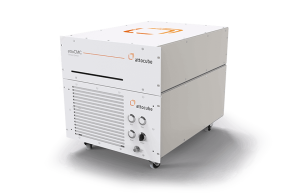
In the same way, attocube’s enabling technologies – among them the attoCMC cryostat – also underpin Sparrow’s pivot to address explicitly industrial metrics needed for turnkey deployment of Sparrow Core chips in full-stack quantum computing systems. Repeatability, energy-efficiency and manufacturability, for example, are key ingredients towards scalability: the attoCMC cryostat delivers exactly that by combining cryogenic performance with a compact and rack-ready design.
“We have a high percentage of PhD physicists in our ranks,” notes Otto, “with many of them trained in similar optics laboratories and therefore able to understand Sparrow’s evolving technical requirements at a granular level.” At the end of the day, attocube cryostats and low-temperature nanopositioners are helping the Sparrow team to set new performance benchmarks for quantum-dot sources – not just in terms of efficiency, but also alignment stability and reproducibility. “All of which are critical for industrial-scale deployment,” adds Otto. “Along the way, attocube is learning and growing in tandem with quantum start-ups and scale-ups [like Sparrow and its peers] as they commercialize their quantum technologies.”
That’s a view echoed by Lodahl, who highlights the importance of attocube products to Sparrow’s R&D success and technology innovation, easing the transition of Sparrow Core out of the lab and into the marketplace. “When we first started working with quantum dots around 20 years ago, cryostats were complicated, unstable and temperamental systems,” he explains. “With its emphasis on continuous product improvement, attocube has changed the game and made cryogenics far more accessible, push-button and reliable.”
Better together
Operationally, knowledge-share and reciprocity have always been central to the vendor-customer relationship between Sparrow and attocube – and even more so as attocube evolves to address diverse industrial imperatives across the quantum supply chain. Take Sparrow’s push for ever-more compact and rack-mountable cryostats – a requirement that, in turn, is being fed into attocube’s product development roadmap.

It’s all about partnership: “Our leading-edge capabilities in cryogenics and precision motion are the ‘quiet enablers’ of quantum innovation,” says attocube’s Florian Otto.
“Regarding the cryostat,” says Lodahl, “the challenge is how compact can we get and how efficient can we get to cool down to 4K. Ultimately, it’s all about how we can further optimize, scale and speed up R&D and testing of our devices. One thing is certain: the open dialogue with attocube will be essential as we continue to exploit its enabling technologies to develop the engineering subsystems around Sparrow Core.”
The future’s looking bright – and busy – for Lodahl and his team. “Our next generation of photonic chips and subsystems – including multiphoton entanglement sources – will open the path to large-scale, fault-tolerant photonic quantum computation,” he concludes.
“The team of talented physicists and engineers here at attocube is on a parallel trajectory,” adds Otto, “quietly enabling and pushing the boundaries of quantum innovation with our nanopositioning and cryogenic systems.”
Joe McEntee is a scientific editor based in South Gloucestershire, UK.
Solutions for Quantum Applications
high precision components to align, operate and test advanced quantum systems
Cryogenic Nanopositioners >
Piezo-based nanopositioners for cryogenic environments.

Single Photon Sources >
Cryogenic cooling for industrialized brilliant light sources for quantum computing and quantum information processing.
attoDRY800xs >
Compact, standalone optical cryostat with unobstructed optical access for quantum optics experiments.
Cryogenic Probing of PICs >
Sophisticated platforms for alignment of optical fiber probes in testing of photonic integrated circuits & quantum computing chip.
attoDRY800 >
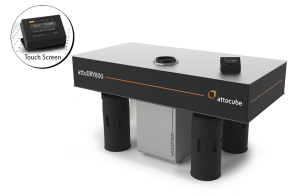
Low-vibration cryostat integrated into an optical table with unobstructed optical access for quantum optics experiments.
Testing of QC Components >
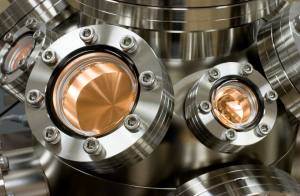
Analysis of mechanical, electrical and optical properties of quantum components before integration into quantum computer systems.
Compact Mobile Cryogenics >
Ultra-compact, complete 4K cryostat system. Designed for easy integration, OEM supply and industrial applications.